


- Data protection risk management involves the systematic identification, analysis, assessment, and mitigation of risks to the rights and freedoms of data subjects in accordance with the GDPR.
- A structured process links processing activities, data protection risk analysis, GDPR risk assessment, and technical and organizational measures (TOM).
- The goal is to document data protection risks in a way that ensures traceability, derive effective measures, and establish an audit-ready data protection management system.
Table of contents
- Why is risk management important in data protection?
- The 5 steps of risk management in data protection under the GDPR
- Step 1: How do I correctly identify data protection risks?
- Step 2: How do I analyze data protection risks?
- Step 3: How do I adequately assess data protection risks?
- Step 4: How do I derive appropriate TOM from the risks?
- Step 5: How do I assess the effectiveness of the measures?
- Implementing risk management in data protection with data protection management software
- Benefits of integrated risk management in data protection
- Frequently asked questions about risk management in data protection
Why is risk management important in data protection?

At its core, data protection management involves risk management. This stems from the General Data Protection Regulation itself: it requires that risks to the rights and freedoms of data subjects be identified, assessed, and mitigated through appropriate measures. Data protection is thus part of an ongoing risk management process with a direct impact on business practices.
The key to a robust risk management in data protection lies in bridging the gap between processing activities (PA) and technical and organizational measures (TOM). In many organizations, however, these elements are still viewed in isolation from one another: Data protection documentation on one side, risk management measures on the other. This results in risks and measures coexisting without any mutual reference - a situation that should be avoided.
An integrated approach combining data protection and risk management, on the other hand, ensures consistency. When risks, protection goals, and TOM are linked, a clear logic emerges: every measure contributes to a specific protection goal, and every risk assessment is clearly documented. This creates a robust system that not only withstands audits by supervisory authorities but also works effectively in practice.
The following guide takes you step by step through a five-step integrated risk management process: from identifying and assessing risks to deriving effective technical and organizational measures.
The 5 steps of risk management in data protection under the GDPR
Effective risk management in data protection ideally follows a five-step approach: risk identification, data protection risk analysis, GDPR risk assessment, derivation of appropriate measures, and assessment of residual risk.
- Risk Identification
- Starting point: Record of Processing Activities (RoPA)
- Derivation of relevant protection goals
- Compilation of potential data protection risks
- Data protection risk analysis
- Distinction between threats and vulnerabilities
- Analysis of causes and risk scenarios
- Mapping with affected protection goals
- Initial Risk Assessment
- Assessment of probability of occurrence and extent of damage
- Classification using a risk matrix
- Assessment of inherent risks prior to implementation of TOM
- Risk treatment through TOM
- Selection of appropriate technical and organizational measures
- Linking risks, protection goals, and TOM
- Documentation in the data protection management system
- Final Risk Assessment
- Reassessment of residual risk following implementation of measures
- Verification of effectiveness
- Update in the event of changes to processes, systems, or the legal status
Below, we outline in detail what needs to be done in each step.
Step 1: How do I correctly identify data protection risks?
Risk identification is the starting point of data protection risk management, and the question is: What risks do we need to protect data subjects against?
The search for the answer begins in the record of processing activities, as this describes what data is processed, how, by whom, and for what purpose. On this basis, the protection goals for each processing activity can be derived from the principles set forth in Article 5 of the GDPR:
- Confidentiality
- Integrity
- Availability
- Transparency
- Intervenability
- Unlinkability
- Data Minimization
These principles form the conceptual framework within which risks are identified.
A real-world example illustrates the approach:
A company uses software for its newsletter. If a date of birth field is added (without first assessing the associated risks), data minimization is violated. If the email tool fails, availability is compromised. If unencrypted address lists fall into the wrong hands, confidentiality is compromised. And if the privacy policy contains unclear information, this poses a potential risk to transparency.
Risk identification therefore means systematically identifying potential threat scenarios while always keeping the relevant protection goals in mind.
To establish a solid factual basis, structured methods are helpful, such as workshops with departments or subject matter experts, as well as the use of pre-existing data protection risk catalogs.
Step 2: How do I analyze data protection risks?
Once the risks have been identified, the next step is risk analysis, with the key question: How do risks arise in detail?
Risks can be examined based on two categories: threats and vulnerabilities.
- Threats are events or circumstances that can cause harm, such as technical failures, human error, or external factors like force majeure.
- Vulnerabilities, on the other hand, are the internal system or organizational factors that make a threat possible in the first place. A lack of an authorization policy, unclear responsibilities, or outdated software are classic vulnerabilities.
The goal of the analysis is to make the risk landscape more tangible: Which combination of threat and vulnerability can lead to what kind of damage, and how does this affect which protection goal?
A real-world example:
Unauthorized access to data in a CRM system violates the protection goal of confidentiality. Potential threats could include phishing attacks or the unauthorized disclosure of passwords. Vulnerabilities, on the other hand, could include a weak password policy and the lack of two-factor authentication.
Risk analysis is therefore about understanding the causes, mechanisms, and interrelationships of potential risks.
Step 3: How do I adequately assess data protection risks?
Risk assessment translates the analysis results into a reliable basis for decision-making.
The key question is: How likely is it that risks will occur, and how significant is the potential damage?
In this step, you determine the probability of damage occurring as well as the possible consequences or extent of damage. The protection of the rights and freedoms of data subjects is always paramount.
To ensure that the extent of damage and the probability of occurrence are assessed as objectively, consistently, and reliably as possible, predefined assessment levels are required.
For guidance, graded assessment criteria have become established in practice, such as those of the Bavarian State Office for Data Protection Supervision (BayLfD) or those of the Data Protection Conference (both sources are only available in German). They distinguish four levels of probability of occurrence, ranging from “negligible” (practically impossible) to “high” (likely), and four levels of severity of harm, ranging from “minor inconvenience” to “irreversible consequences.”
In the following overview, we follow the model recommended by the BayLfD:
Assessment levels for the likelihood of occurrence in data protection
| Level | Description |
| Minor | Damage is not expected to occur based on current expectations. |
| Manageable | Although damage may occur, based on past experience or given the current circumstances, it appears unlikely to occur. |
| Substantial | Based on past experience and the current circumstances, damage appears possible but not very likely. |
| Major | Based on past experience and the current circumstances, damage appears to be possible and very likely. |
Levels of the extent of damage
| Level | Description |
| Minor | Affected individuals may experience some inconvenience, but they can overcome it with a few difficulties. |
| Manageable | Those affected may experience significant inconvenience, but they can overcome it with some difficulty. |
| Substantial | Those affected may experience significant consequences, which they can overcome only with serious difficulty. |
| Major | Those affected may suffer significant or even irreversible consequences that they cannot overcome. |
Important: In the initial assessment, so-called inherent risks are considered. These are risks before technical and organizational measures are taken into account. This determines the theoretical maximum level of inherent risk.
A risk matrix is a useful tool to visually support this assessment. It illustrates the relationship between the severity of damage and the probability of occurrence and aids in risk assessment.
Multiplying the levels results in the following picture:
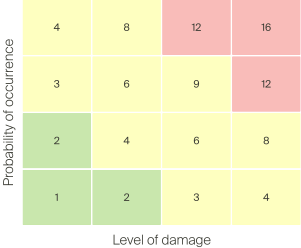
This form of GDPR risk assessment is frequently used in data protection management systems to prioritize risks in a consistent and traceable manner.
The individual fields of the risk matrix can be summarized into a risk index:
- Red: High risk
- Yellow: Normal / Medium risk
- Green: Low risk
When does a risk assessment become a Data Protection Impact Assessment (DPIA)?
Not every data protection risk assessment automatically leads to a Data Protection Impact Assessment (DPIA) under Article 35 of the GDPR. A DPIA is always required when processing is likely to result in a high risk to the rights and freedoms of natural persons.
Typical triggers for a DPIA include:
- extensive processing of special categories of personal data (e.g., data concerning health)
- systematic monitoring of publicly accessible areas
- profiling with significant effects on data subjects
Data protection risk management forms the basis for a DPIA:
The identified risks, their assessment, and the planned technical and organizational measures are directly incorporated into the DPIA documentation.
In practice, risk assessment and Data Protection Impact Assessment are often combined within a data protection management system. Solutions such as caralegal enable both processes to be consistently documented and linked together.
Step 4: How do I derive appropriate TOM from the risks?
Now that the risk assessment has been completed, the subsequent risk treatment defines how risks can be effectively mitigated.
The challenge now is to select the TOM in such a way that they directly reinforce the respective protection goal.
When selecting appropriate TOM, controllers should consider two categories of measures:
The first category concerns technical measures - that is, everything that directly strengthens security systems: backups, encryption, access controls, etc. These measures have a direct impact on the probability of technical risks occurring.
The second category encompasses procedural and organizational optimizations. These include, for example, clear role and responsibility frameworks, pre-defined approval processes, training, or regular reviews of data flows. Risk-aware process adjustments ensure that data protection is not only implemented technically but also integrated into people’s daily work routines.
Effective TOM are not isolated measures that exist purely for their own sake. Only when risks, technical and organizational measures, and protection goals are actively interrelated does a coherent system emerge that supports both compliance and operational activities.
The following examples illustrate how protection goals are placed in direct context with TOM:
- When data availability is at risk, redundant systems, regular backups, and clearly defined recovery times can mitigate.
- When integrity is at risk, checksums, role-based access control, or four-eyes principle take center stage.
- Confidentiality, in turn, requires encryption, access restrictions, and training to raise employee awareness.
- Transparency can be ensured through audit logs or traceable documentation, while
- Intervenability and unlinkability are promoted through clean data structures, pseudonymization, and the separation of processing contexts.
- Data minimization can be ensured by collecting only the data necessary for its intended purpose, for example through reduced mandatory fields in forms or automatic deletion once the purpose no longer applies.
In addition, the SDM modules published by the German Data Protection Conference (DSK) as part of the Standard Data Protection Model (SDM) can be utilized. They provide a practical foundation for the targeted implementation of technical and organizational measures.
Step 5: How do I assess the effectiveness of the measures?
Risk management does not end with the definition and subsequent implementation of TOM. On the contrary: Once this is done, it is necessary to verify whether the measures taken have actually led to a reduction in risk.
Step 5 represents the final risk assessment. This second assessment cycle, in which the so-called residual risk is evaluated, is intended to provide evidence that the risks have been reduced to an acceptable level. Residual risk refers to the risk remaining after all appropriate TOM have been implemented.
Thus, the probability of occurrence and the extent of loss are reassessed for the mitigated risks.
The focus here should be on traceability: supervisory authorities should be able to see how the company arrived at its risk assessment.
In addition, it is advisable to regularly review the operational effectiveness of the TOM: whether through internal audits, departmental reviews, or audit rights in contractual relationships. This involves not only technical checks but also organizational reviews: Are policies being followed? Are responsibilities clearly defined? Is employee awareness being maintained?
The final risk assessment is not a one-time action, but a continuous cycle: new projects, systems, or legal changes should always trigger an update to the risk management framework.
Implementing risk management in data protection with data protection management software
In practice, it is evident that effective risk management in data protection is hard to manage using isolated Excel spreadsheets or individual documents. Controllers need a data protection management system that links risks, processing activities, and technical and organizational measures.
Specialized data protection software such as caralegal supports this, among other things, through:
- centralized maintenance of the record of processing activities as the starting point for risk identification
- integrated risk catalogs and assessment logic for data protection risk analysis
- libraries of technical and organizational measures that can be directly linked to protection goals
- a complete audit trail that provides traceability in documenting changes to risks and measures
- reporting functions that allow the GDPR risk assessment to be demonstrated to internal and external stakeholders
This transforms an abstract risk concept into a practical, documented process that integrates seamlessly into the data protection management system.
Benefits of integrated risk management in data protection
Integrated risk management is a prerequisite for effective data protection management. Data protection can only be effectively implemented if risks are systematically identified, assessed, and addressed. An integrated approach is the key to success: risks, protection goals, and technical and organizational measures are linked together in a consistent system.
At the same time, practical experience shows that such a system is only sustainable in the long term if it is continuously maintained and reviewed. Digital support can significantly facilitate this process. After all, risk management requires structure: clear assessment templates, traceable risk and measure templates, and centralized administration.


